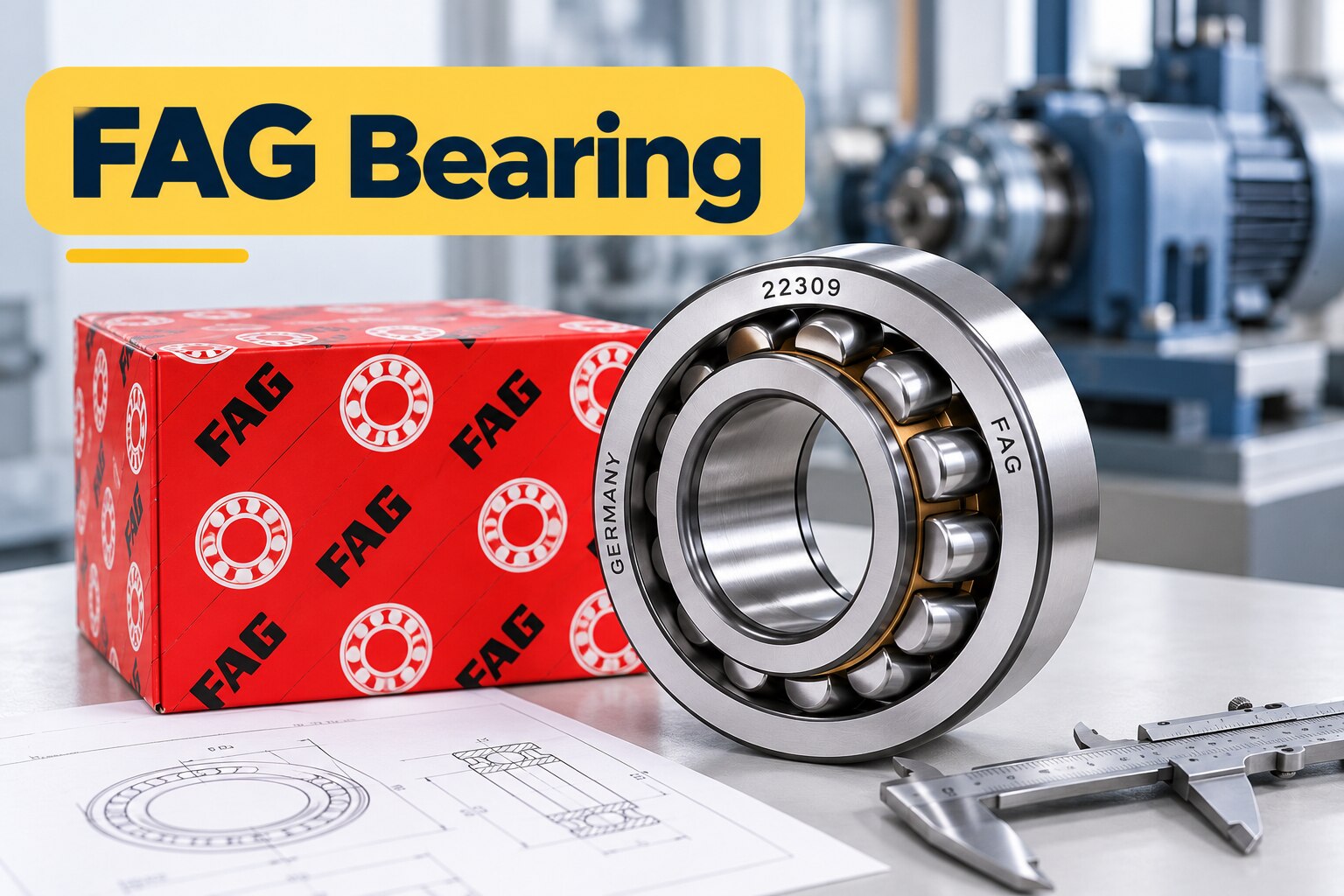
Start by confirming that 22309-E1-XL-T41A is a two-row spherical roller bearing and not a deep groove ball bearing, then check the complete designation rather than the base number alone. By the end, you will have a practical method for matching its dimensions, load ratings, speed, clearance, alignment, sealing and lubrication requirements to your machine.
Key takeaways
- Confirm 22309-E1-XL-T41A is a spherical roller bearing before ordering.
- Check shaft, housing and bearing envelope dimensions against the published FAG specification.
- Select load rating, speed and internal clearance for the machine’s actual duty.
- Treat self-alignment and seals as design features, not substitutes for correct installation.
Confirm the bearing type, designation and published specification
The 22309-E1-XL-T41A is a two-row spherical roller bearing, not a deep-groove ball bearing. The 22309 designation identifies the bearing series and size; E1 identifies FAG’s internally optimised spherical-roller design, while XL denotes the X-life performance version.
Confirm T41A in the current FAG/Schaeffler designation table before substitution: its cage material and guidance affect speed, acceleration, vibration tolerance, lubrication compatibility and shock resistance.
The base 22309 envelope is typically 45 mm bore, 100 mm outside diameter and 31 mm overall width. Those dimensions do not complete the purchasing specification. Check the exact catalogue entry and record these 22309 fag bearing specifications:
| Catalogue figure | What to verify | Why it matters |
|---|---|---|
| Bore, d | 45 mm | Confirms the shaft fit |
| Outside diameter, D | 100 mm | Confirms the housing bore |
| Width, B | 31 mm | Confirms axial space |
| Dynamic load rating, C | Current FAG value | Determines fatigue-load capacity |
| Static load rating, C0 | Current FAG value | Checks stationary and shock loading |
| Reference and limiting speed | Both published values | Separates normal operation from maximum permissible speed |
| Mass | Current catalogue value | Checks handling and rotating inertia |
Do not remove E1, XL or T41A from the order description. Compare the complete string with the supplier’s document; “22309 e1 xl t41a bearing uses” is not proof that a visually similar bearing is equivalent. Also verify clearance, cage execution and lubrication limits before accepting a substitute.
Match the 22309 envelope to the shaft and housing
A 22309 FAG bearing for selection starts with a physical envelope check: the shaft must accept a 45 mm bore, the housing must provide a 100 mm seat, and the available axial space must exceed the 31 mm bearing width.
Measure the machine rather than relying on an old drawing. Check these dimensions:
- Shaft diameter along the seating length, including wear, plating and taper
- Housing bore diameter, roundness and surface condition
- Shaft and housing shoulder diameters
- Shaft and housing fillet radii
- Axial space for the bearing, locating shoulder, retaining ring and any spacer
The shoulder diameter must support the bearing ring without touching the cage or rollers. A fillet radius larger than the bearing’s chamfer clearance will hold the ring away from its seat, leaving the bearing misaligned or incompletely supported. Compare the measured radius and shoulder dimensions with the FAG catalogue drawing for the exact 22309 execution.
The 45 mm dimension is the nominal bore, not automatically the finished shaft size. A ring carrying a rotating load normally needs an interference fit to prevent creep; the required shaft tolerance depends on load, shock, temperature and which ring rotates.
Do not make both rings excessively tight, because the fit reduction consumes internal clearance and can overheat the bearing.
Also verify that the housing can accommodate the bearing’s outside diameter and that axial expansion or locating arrangements do not clamp the 31 mm width. Confirm the catalogue’s boundary dimensions before ordering a 22309 FAG bearing for selection.
Choose load capacity, speed and internal clearance for the duty
Treat an FAG XL bearing for machinery as a load-and-speed calculation, not a size match. Compare the calculated equivalent dynamic load P with the catalogue dynamic rating C, and the maximum static equivalent load P0 with C0. Include the axial component and use FAG’s combined-load factors; do not judge suitability from radial load alone.
| Duty | Compare against FAG rating | Selection consequence |
|---|---|---|
| Radial load | P versus C; peak load versus C0 | Confirm fatigue life and static safety |
| Axial load | Axial force with radial load using catalogue equations | Use the spherical roller bearing only when radial load remains dominant |
| Shock or impact | Peak force, impact frequency and application factor | Increase safety margin; inspect for brinelling risk |
| Combined load | Radial and axial forces over the duty cycle | Recalculate for each operating condition, not only nominal load |
| Speed | Operating speed against reference and limiting speeds | Check lubrication, cage execution and heat before accepting the rating |
Choose standard internal clearance for normal fits, ordinary temperature differences and a rigid, correctly aligned housing. Choose C3 when a tighter interference fit or a shaft hotter than the housing will consume part of the running clearance.
Use C4 or another specified execution only when the FAG catalogue calculation or the machine temperature and fit demand it; excessive clearance reduces load sharing and increases vibration. Check the 22309 FAG bearing specifications for the exact clearance range, because E1, XL and T41A do not by themselves establish every operating limit.
A spherical roller bearing suits shock-loaded conveyors or crushers better than a cylindrical roller bearing when housing misalignment exists, but a dedicated thrust bearing wins when axial load dominates.
Use self-alignment, sealing and lubrication without hiding installation faults
Self-alignment does not make a bent shaft or distorted housing acceptable. A spherical roller bearing still needs a rigid, correctly machined housing, adequate shoulder support and permissible misalignment for the actual load, speed, clearance, cage and lubricant. Excess misalignment raises friction and edge loading until the rollers or raceways fail.
Check these points before fitting:
- Alignment: Measure shaft runout, housing alignment and shaft shoulders. Correct a bent shaft or soft, distorted housing instead of relying on the bearing’s self-aligning feature.
- Sealing: An open 22309 execution needs effective shaft and housing seals. Select the seal material and lip arrangement for the temperature, water, abrasive dust and shaft speed; contamination can destroy the raceways before fatigue life is reached.
- Cage: Verify T41A in the current FAG/Schaeffler designation table. Cage material and guidance affect allowable speed, acceleration, vibration tolerance, shock resistance and grease compatibility, so a visually identical cage is not an equivalent replacement.
- Lubrication: Confirm grease or oil suitability, viscosity, operating temperature, fill quantity and relubrication interval. Do not mix incompatible greases, and keep tools, housings and lubricant clean.
- Mounting: Check the measured shaft and housing fits, locking method and required radial clearance. Heat the inner ring evenly with an induction heater when interference fitting; never drive force through the rollers or seals.
Record the removed designation, clearance class, cage suffix, lubricant, temperature and failure mode. That evidence matters when evaluating 22309 e1 xl t41a bearing uses or choosing an FAG XL bearing for machinery. The complete designation, not just “22309,” must match the duty.
Apply the selection method to real machinery and replacement orders
Use load, speed and alignment—not the machine label—for 22309 fag bearing for selection. The 22309-E1-XL-T41A is a two-row spherical roller bearing for high radial load, combined axial load and housing-to-shaft misalignment; it is not suitable when thrust dominates or speed exceeds the exact cage-and-lubricant limit.
The phrase 22309 e1 xl t41a bearing uses is only a starting point: retain E1, XL and T41A and verify the complete designation in the current FAG table.
| Equipment | Suitable when | Reject or recheck when |
|---|---|---|
| Conveyors | Heavy radial load, shock and moderate speed are documented | Belt tension, impact or speed exceeds the ratings |
| Gearboxes | Radial load combines with limited axial load and housing misalignment | Gear thrust dominates or oil compatibility is unconfirmed |
| Fans | Radial load fits the rating and the cage, oil or grease speed limit is adequate | High speed creates excess heat or vibration |
| Crushers and screens | Shock and static-load checks include stopped and peak conditions | Static capacity or clearance is inadequate |
| Pumps | Radial load and limited axial load are measured at operating speed | A dedicated thrust bearing carries the main axial load |
| Paper machinery | Continuous load, alignment and lubrication conditions match the catalogue | Contamination, speed or temperature exceeds the execution limits |
- Complete designation, old bearing markings and clear photos
- Measured shaft diameter, housing bore, width and shoulder dimensions
- Radial, axial and shock loads, including peak and stationary loads
- Operating speed, temperature, acceleration and grease or oil method
- Required clearance, fits, mounting method, contamination and relubrication interval
Related product
 | Bearing 22309-E1-XL-T41A Fag Ball Bearings Bearing Type Deep Groove Ball Bearing Sealing One side seal Number of Rows Single Row Application Industrial The FAG 22309-E1-XL-T41A is a spherical... View product → |
Frequently asked questions
What type of bearing is the 22309-E1-XL-T41A?
It is a two-row spherical roller bearing. The 22309 designation identifies its series and size, E1 identifies FAG’s internally optimised design, and XL denotes the X-life version.
How do you match a 22309 bearing to a shaft and housing?
Compare the published bore, outside diameter and width with the shaft and housing dimensions. Check the fit, shaft tolerance, housing seat and available clearance before ordering.
How should you choose load capacity, speed and internal clearance?
Match the bearing’s dynamic and static load ratings to radial and axial loads, verify the reference speed against operating speed, and select internal clearance for the shaft fit, temperature and duty.
Do self-alignment and sealing correct installation problems?
No. Self-alignment accommodates shaft and housing misalignment within its limits, while sealing controls contamination and lubricant loss. Neither feature fixes incorrect fits, damaged seats or poor mounting.
What information belongs on a 22309 bearing replacement order?
Record the complete designation, including suffixes such as E1, XL and T41A, along with dimensions, clearance, seal or cage details, lubricant requirements and the machine’s operating conditions.
Keywords