A bearing that arrives quickly is not a saving if its clearance, seal, fit or traceability is wrong. Delhi machinery buyers can reduce downtime and replacement risk by comparing sourcing routes, sending complete application data, verifying worn markings and controlling the bearing from receipt through installation.
Key takeaways
- Compare total downtime and freight costs, not just the bearing unit price.
- Send bearing markings, dimensions, load details and operating conditions with every quotation request.
- Match seals, grease, clearance and load rating before accepting an equivalent replacement.
- Record installation evidence and failure symptoms to prevent repeat bearing damage.
Why local bearing sourcing can reduce downtime and total cost
Local sourcing reduces downtime when the supplier confirms the exact specification and has stock you can inspect, collect or dispatch quickly. The practical test for industrial bearing supplier benefits in Delhi is total sourcing effort: compare a lost production shift, uncertain freight and replacement delay against a slightly lower distant unit price.
| Option | Best use | Check before ordering |
|---|---|---|
| Manufacturer | Engineered, safety-critical or traceable applications | Manufacturer approval, full designation, batch traceability |
| Authorised distributor | Genuine branded stock and technical support | Authorisation, delivery promise, replacement policy |
| Industrial bearing supplier in Delhi | Mixed maintenance requirements and local availability | Stock, MOQ, dimensions, fits, technical support and returns |
| Online marketplace | Standard, non-critical items | Seller identity, packaging, markings and documents |
| Local reseller | Immediate need when alternatives are unavailable | Identity, condition, origin and documentation |
A Delhi supplier can check local stock, arrange urgent pickup or dispatch to industrial areas, clarify bore, outside diameter, width, clearance, seal code, speed and load, and coordinate a replacement without sending the failed part across the country.
You also gain easier inspection and returns; distant orders add freight uncertainty, minimum-order constraints and slower after-sales handling.
Before comparing quotes, ask for:
- Full designation and revision, quantity, delivery deadline and minimum order quantity
- Packaging identification, batch or lot information, country of origin where required and conformity documents
- Shaft and housing fits, load direction, speed, temperature, lubricant, seal or shield type and clearance or preload
- Replacement terms, technical escalation and approval for any documented substitution
Local accountability matters only with specification control. A nearby unverified bearing creates the same downtime risk as a distant one.
What to send with a quotation request and how to verify a worn bearing
Send a quotation request that identifies the operating duty, not just “6205 bearing.” Include:
- Full bearing number and revision, bore, outside diameter, width, radial or axial load direction, speed, temperature, seal or shield code, internal clearance or preload, precision class and cage requirement.
- Lubricant, shaft and housing fit, brand preference, quantity, certificate or batch-traceability requirement and delivery deadline.
- For high-speed machinery, add duty cycle, limiting-speed assumptions, cage material, lubricant quantity, heat dissipation and preload or clearance. Static load rating alone does not validate continuous high-speed operation.
An incomplete request invites a visually similar substitution with different clearance, seal friction or load capacity. That is a common failure in industrial bearing sourcing in Delhi and elsewhere.
If markings are unreadable, measure the shaft diameter, housing bore and bearing width using clean, calibrated instruments. Record scoring, looseness, fretting or damage on both shaft and housing, then match the measurements to the manufacturer catalogue; do not identify the bearing by appearance.
Motion type changes the request:
| Option | Identify it by | Send these additional details |
|---|---|---|
| Rotary bearing | Rolling element rotates with a shaft | Radial or axial load, speed and fits |
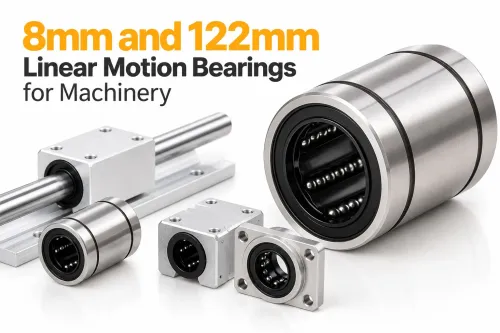
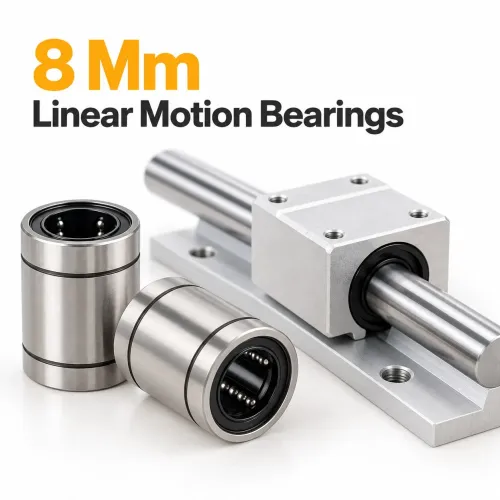
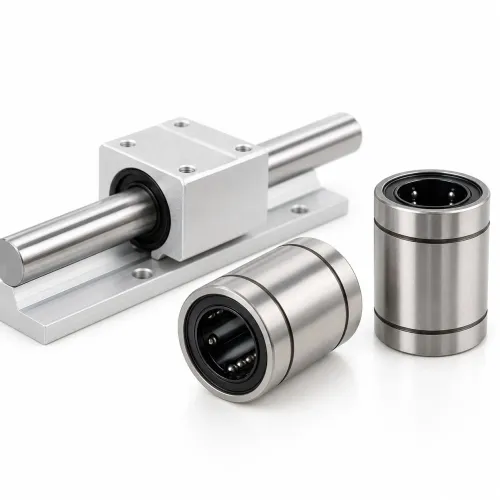
| Linear bushing | Reciprocates along a shaft | Stroke, speed, acceleration, load and lubrication |
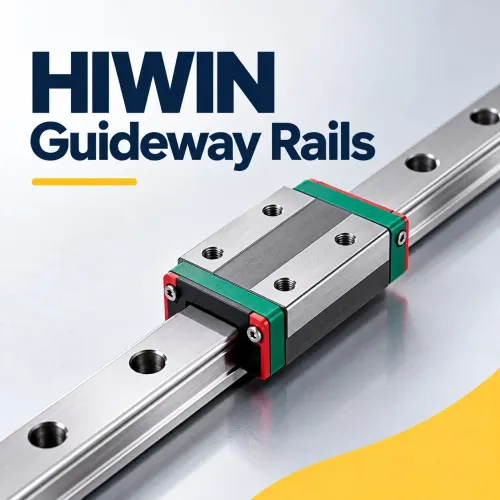
| Profile-rail block | Runs on a guide rail | Stroke, load, moment, preload and accuracy |
| Ball-screw support | Supports screw rotation | Axial load, speed, preload and runout |
| Mounted bearing | Insert sits in a housing | Housing type, shaft tolerance, end-float, locking method and existing-housing condition |
A worn housing or damaged set-screw, eccentric collar or adapter sleeve can defeat a new insert. Verify the locking procedure before ordering.
How to compare bearing designs and supposedly equivalent replacements
Choose the design from the machine duty, not from the brand name you recognise. For industrial bearings for machinery, compare these choices:
| Design | Select it when | Main caution |
|---|---|---|
| Deep-groove | Combined radial and moderate axial loads at common speeds | It is not a substitute where axial stiffness or directional preload matters |
| Angular-contact | Axial load, stiffness or preload direction matters | Confirm contact angle and paired arrangement |
| Self-aligning | Shaft or housing misalignment is expected | It does not correct poor fits or severe deflection |
| Double-row | Higher radial capacity or stiffness is needed within the available envelope | Check width, clearance and axial-load limits |
| Needle-roller | Radial capacity must fit a compact radial space | Shaft raceway, lubrication and alignment become critical |
| Linear guideway | Motion travels along a rail rather than rotating | Compare stroke, speed, acceleration, load, moment and preload |
Call a replacement equivalent only after comparing dynamic and static load ratings, the L10 calculation basis, limiting-speed assumptions, precision class, internal clearance, cage material, seals or shields, dimensional tolerances, lubricant and preload.
L10 means 90% of an identical bearing population reaches that life under stated load, speed, lubrication and contamination assumptions; it is not an individual-bearings guarantee.
C3 is not automatically better or higher capacity. Select it for interference fits or temperature differences that could eliminate running clearance; excessive clearance increases noise, vibration, wear and poor load distribution.
For high-speed machinery, request cage, lubricant quantity, heat-dissipation and duty-cycle data. Static load rating alone does not validate continuous high-speed operation. Also confirm which ring carries the rotating load, shaft and housing fits, temperature and required axial displacement.
How seals, grease and operating conditions change the specification
Seal choice starts with contamination and heat trade-offs. Use seals where dust, abrasive particles or moisture demand strong exclusion. Choose shields where cleaner conditions make lower contact friction and drag more valuable. Use an open bearing only when the housing, oil system or maintenance practice protects it.
| Option | Choose it when | Main trade-off |
|---|---|---|
| Sealed bearing | Dust, abrasive particles or washdown exposure is high | Better exclusion, but more seal friction, heat and restricted service access |
| Shielded bearing | The environment is clean and low drag matters | Lower friction, but weaker contamination protection |
| Open bearing | Housing, oil circulation or scheduled maintenance provides protection | Best access and lubrication flexibility, but contamination enters easily |
Compare washdown exposure, operating temperature and the manufacturer’s approved lubricant before choosing. Delhi dust, seasonal humidity and temperature variation make intact packaging, clean storage and suitable preservation important; they do not justify the heaviest seal or thickest grease by default.
Specify grease by thickener, base oil, viscosity, additives and operating temperature. Matching viscosity alone does not prove compatibility. Do not mix greases without compatibility confirmation and purge instructions; incompatible thickeners can cause hardening, softening or oil separation.
Treat oil seals as separate engineering items. Give an industrial bearing supplier in Delhi the shaft diameter, speed, pressure, temperature, fluid, shaft finish, runout and installation geometry. A nominally correct seal can fail on a worn shaft or with an incompatible elastomer.
How to control quality from delivery through installation and failure diagnosis
Treat delivery as the first quality check, not an administrative step. For industrial bearing sourcing in Delhi, require traceability before accepting a short lead time or an unverified substitute.
1. On receipt, match the invoice with the manufacturer packaging, full designation, batch or lot number, country of origin where required, and conformity paperwork. Reject stock with broken packaging, corrosion, impact marks, mixed labels, incorrect markings, or evidence of prior opening.
2. Store bearings horizontally in a clean, dry, humidity-controlled area. Keep the original wrapping intact, rotate stock FIFO, and open a sealed bearing only at installation.
3. During mounting, apply force only through the ring being fitted. Never hammer through rolling elements, force an incorrect fit, misalign housings, over-tighten locking hardware, or heat beyond the manufacturer’s specified method and temperature.
Record symptoms before removing a failed bearing. Rising temperature or noise points to lubrication or clearance problems; vibration and raceway marks suggest mounting damage or false brinelling. Spalling indicates fatigue, overload, or contamination. Electrical fluting indicates current passage, while corrosion indicates moisture or poor preservation.
A general bearing supplier for maintenance buyers is not enough for high-speed spindles, certified safety-critical machines, unusual temperatures, heavy shock loads, cleanrooms, food-contact equipment, or applications requiring manufacturer engineering approval. Shreeji Industrial Corporation LLP adds practical value when it documents specification checks, traceability, replacement coordination, and technical escalation instead of offering an unverified substitute.
Related product
 | Industrial Ball Bearing Material Bearing Steel Shape Round Packaging Size as per quantity Packaging Type Box/ bags Type Ball Bearing Grade All grades available Industrial... View product → |
Frequently asked questions
How can a local industrial bearing supplier reduce machinery downtime?
A Delhi supplier can reduce delay when it confirms the exact specification and offers stock for inspection, collection or quick dispatch. Compare those savings with the cost of a lost production shift and uncertain freight.
What should you include in a bearing quotation request?
Send the bearing number, manufacturer marking, shaft and housing dimensions, load and speed, temperature, seal requirements, lubrication details and the machine application.
How do you verify whether a worn bearing needs replacement?
Record the bearing markings, inspect raceways and rolling elements for pitting, spalling, scoring or discoloration, and check fit, play, contamination and lubrication before selecting a replacement.
What must you compare when a replacement bearing is called equivalent?
Compare dimensions, load ratings, speed rating, internal clearance, cage design, sealing, precision class, material and lubrication. A matching part number alone does not prove functional equivalence.
How do seals, grease and operating conditions affect bearing selection?
Dust, water, temperature, speed, load and relubrication access determine the seal type, grease consistency, operating-temperature range and bearing clearance required.
Keywords