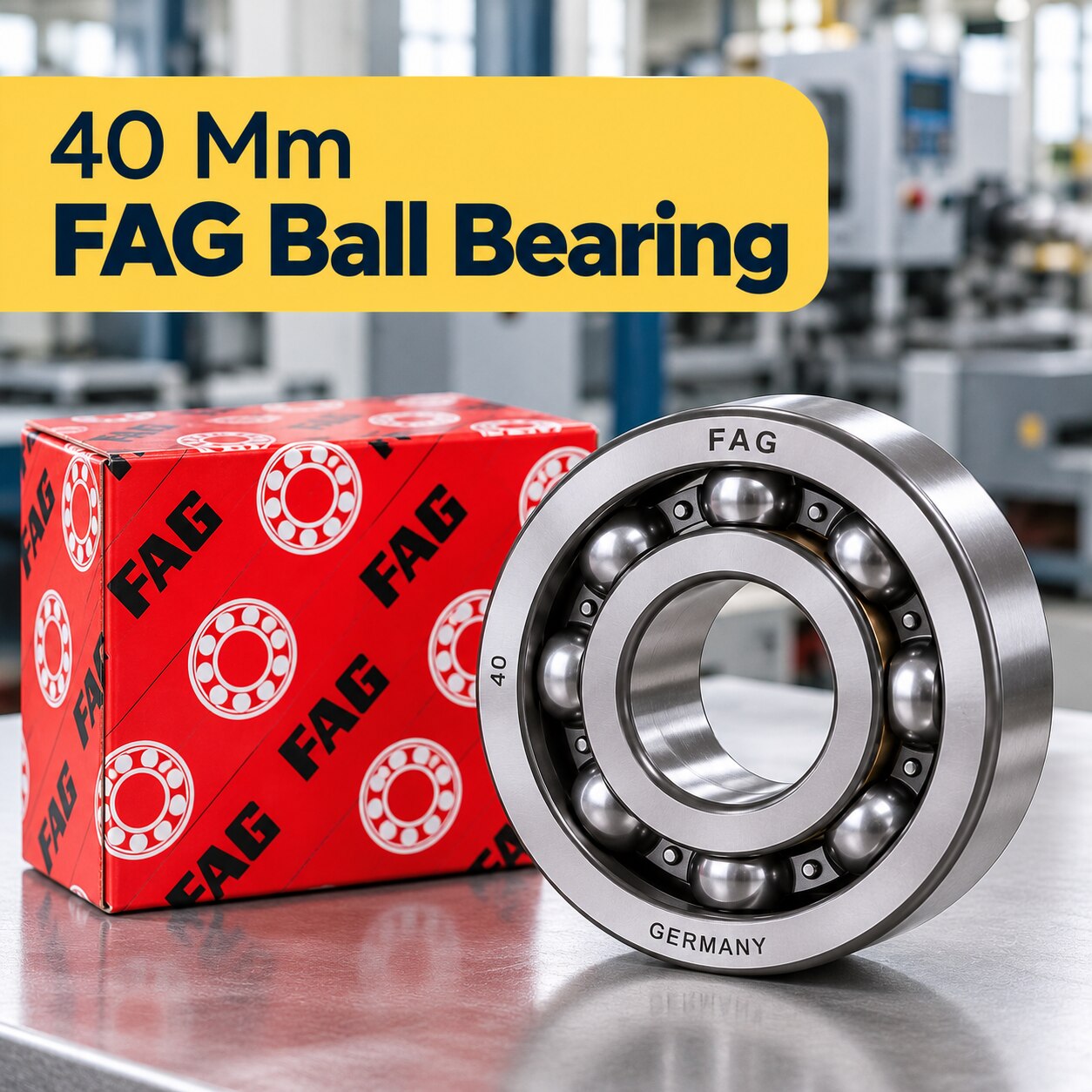
The number 40 mm identifies only one dimension in many FAG bearings, usually the bore, so it cannot identify a replacement by itself. By the end, you will be able to decode the full designation, compare dimensions and load ratings, verify fits and seals, and order the correct bearing without repeating an underlying machine fault.
Key takeaways
- Confirm 40 mm is the bore, then verify outside diameter and width.
- Calculate load, life and speed before comparing FAG bearing specifications.
- Check shaft fit, housing tolerance, mounting method and misalignment limits.
- Match seals and grease to temperature, contamination, moisture and relubrication access.
Confirm what “40 mm” means before reading the catalogue
“40 mm” normally identifies the bore, not the outside diameter or width. Start your FAG bearing size guide by confirming all three boundary dimensions: bore × outside diameter × width.
| Part number | Bore × outside diameter × width | What the series changes |
|---|---|---|
| 6208 | 40 × 80 × 18 mm | Smaller envelope and lower load capacity |
| 6308 | 40 × 90 × 23 mm | Higher load capacity, greater housing space |
| 6408 | 40 × 110 × 27 mm | Higher load capacity, largest envelope |
The larger series needs more radial space and can add friction, mass and cost. The code 08 commonly indicates a 40 mm bore in metric deep-groove bearings, but special and non-metric series follow different rules. Check the complete FAG catalogue entry.
Read the full designation before ordering. Confirm the bearing family, series, cage construction, internal clearance such as C3, seal or shield suffix such as 2Z or 2RSR, and accuracy class such as P0 or P6. P6 improves dimensional and running accuracy; it does not increase load capacity or seal quality.
A self-aligning ball bearing has an outer-ring spherical raceway; a deep-groove bearing has fixed raceways and is not self-aligning. Request the exact drawing, catalogue page and 40 mm FAG bearing specifications for the proposed part number.
Match the bearing to loads, life, misalignment and speed
A self-aligning FAG ball bearing suits shaft or housing misalignment only within its catalogue angle; never assume every model tolerates the same movement. Record these conditions before choosing a 40 mm FAG ball bearing:
- Radial and axial loads
- Speed, temperature and duty cycle
- Shock, standstill or oscillation
- Required service life and contamination exposure
For a ball bearing, calculate basic rating life as L10 = (C/P)^3 million revolutions. C is the basic dynamic load rating, while P is the equivalent dynamic load. Convert life to hours with L10h = 10^6(C/P)^3 ÷ (60n), where n is speed in revolutions per minute.
For combined loading, use the manufacturer’s X, Y and e factors; radial load alone is not P.
| Bearing choice | Suitable condition | Reject or reconsider when |
|---|---|---|
| Self-aligning ball | Limited misalignment and moderate loads | Angle, axial load, speed, temperature or cage limit is exceeded |
| Deep-groove ball | Ordinary radial and moderate axial load | Axial or combined-load direction demands angular contact |
| Angular-contact ball | Greater directional axial or combined load | High radial load requires a roller design |
| Cylindrical or spherical roller | Higher radial load | Ball-bearing speed or space limits are essential |
Check maximum equivalent static load against C0 and apply a suitable safety factor for shock, standstill or oscillation. A FAG bearing for industrial machinery also needs a catalogue check for sealing, lubricant and permissible speed; bore size alone does not establish suitability.
Check shaft, housing and mounting conditions before ordering
A 40 mm bearing will fit securely only when measured dimensions match the selected FAG catalogue tolerance and shaft and housing fits. Measure the shaft with a calibrated micrometer at several positions and angles; never trust a nominal “40 mm” label. Measure the housing bore with a bore gauge, then check roundness and taper.
| Fit condition | Usual requirement | What decides it |
|---|---|---|
| Rotating inner ring | Interference fit on shaft | Load direction, speed, temperature and creep risk |
| Rotating outer ring | Interference fit in housing | Load direction, housing temperature and creep risk |
| Stationary ring | Clearance or transition fit may suit | Load, adjustment and mounting method |
Check shoulder diameters, shoulder squareness, fillets and axial abutment against the bearing drawing. Confirm clearance for the outside diameter and width, plus seals, locknuts, spacers and extraction tools.
Interference fits reduce internal clearance. Select normal clearance by default; specify C3 only when thermal expansion, fit interference or operating conditions justify it. Your 40 mm fag bearing specifications should record measured dimensions, intended fits and clearance class.
Remove the old bearing, clean the housing and inspect for fretting, looseness, shaft runout or shoulder damage. Repair those faults before installation; a replacement bearing fitted into a damaged seat will fail again.
Choose sealing, grease and handling for the actual environment
Select the seal for the contamination, lubrication and speed—not just the 40 mm bore. For a FAG bearing for industrial machinery, compare the complete suffix because seals change friction, starting torque, lubricant retention, temperature and permissible speed.
| Option | Protection and friction | Choose it when |
|---|---|---|
| Open | Lowest seal friction; no built-in contamination barrier | The machine provides clean, controlled oil or grease lubrication |
| 2Z | Non-contact shields; low friction and moderate dust protection | You need higher speed with limited dust exposure |
| 2RSR | Contact seals; stronger dust, splash and grease retention | Ordinary contamination or moisture reaches the bearing |
Confirm the exact FAG catalogue entry for the suffix’s limiting speed, temperature range and friction limits. Abrasive slurry, chemicals, high-pressure washdown or submerged service require external seals, shielding or another arrangement; a 2RSR bearing alone is not enough.
Treat a pre-greased sealed bearing as non-relubricatable unless FAG specifies a method. Use the specified grease quantity, and verify thickener and additive compatibility before adding grease; overfilling raises temperature and reduces speed capability. Record the interval, grease point and purge path.
Keep bearings horizontally in original sealed packaging in a clean, dry area, rotating stock by receipt date. During installation, press only on the ring receiving force. Heat an interference-fit inner ring with an induction heater to the FAG-specified temperature; never load the balls, cage or seals.
Verify identity when markings or alternatives are uncertain
A 40 mm bore does not identify a bearing by itself. Prevent a wrong or counterfeit part from entering the machine by verifying the complete FAG part number, manufacturer markings and supplied documents before installation.
Inspect the bearing for:
- Clear FAG markings, consistent font, and undamaged races, cage and seals.
- A box label that exactly matches the bearing designation.
- Intact packaging, batch or lot traceability, and a certificate or delivery record naming the supplied part.
If the removed bearing has only a partial marking, photograph every visible character, measure its bore, outside diameter and width, and check the machine drawing, maintenance manual or OEM part list. Use a 40 mm FAG bearing size guide and the full 40 mm FAG bearing specifications; never infer the part from bore size alone.
Compare an alternative designation only across every relevant characteristic:
| Criterion | Original FAG part | Proposed alternative |
|---|---|---|
| Boundary dimensions | Bore, outside diameter, width | Must match |
| Capacity | C and C0 ratings | Must match application |
| Construction | Clearance, cage, seals, lubricant | Must match |
| Performance | Accuracy, speed limit, misalignment | Must meet requirements |
Nominal interchangeability is not functional interchangeability. Investigate contamination, wrong fit, excessive load, poor lubrication or shaft runout, because each can quickly destroy a correct-looking substitute. Keep the removed bearing until the replacement and dimensions are verified.
Use a purchasing checklist that captures the machine’s real requirements
Put the machine’s duty on the request, not merely “40 mm FAG ball bearing for selection.” State the exact FAG family, complete part number, quantity, and dimensions: bore × outside diameter × width.
| Bearing design | Specify | Do not assume |
|---|---|---|
| Self-aligning ball bearing | Required misalignment angle and catalogue limit | Equivalent to deep-groove |
| Deep-groove ball bearing | Fixed raceways and moderate axial load | Self-aligning |
| 2Z or 2RSR | Shield or contact-seal arrangement | Interchangeable protection |
Include these fields:
- Radial load, axial load, speed, duty cycle, shock, operating temperature, contamination and moisture exposure.
- Internal clearance, cage type, accuracy class, lubricant, shaft fit, housing fit and required misalignment capability.
- Whether the part must match an OEM drawing; request the FAG catalogue reference, factory-greased status, relubrication method and speed suitability.
- Require batch traceability, intact packaging, delivery documentation and return terms for an incorrect or damaged bearing.
For fag bearing for industrial machinery purchases, Shreeji Industrial Corporation LLP can compare the complete designation with your measured dimensions and duty when you provide this information.
Before acceptance, check the marking and seals, measure the replacement, and review the fit. This takes longer than a bore-only order, but prevents repeated removal, cleaning, downtime and replacement.
Related product
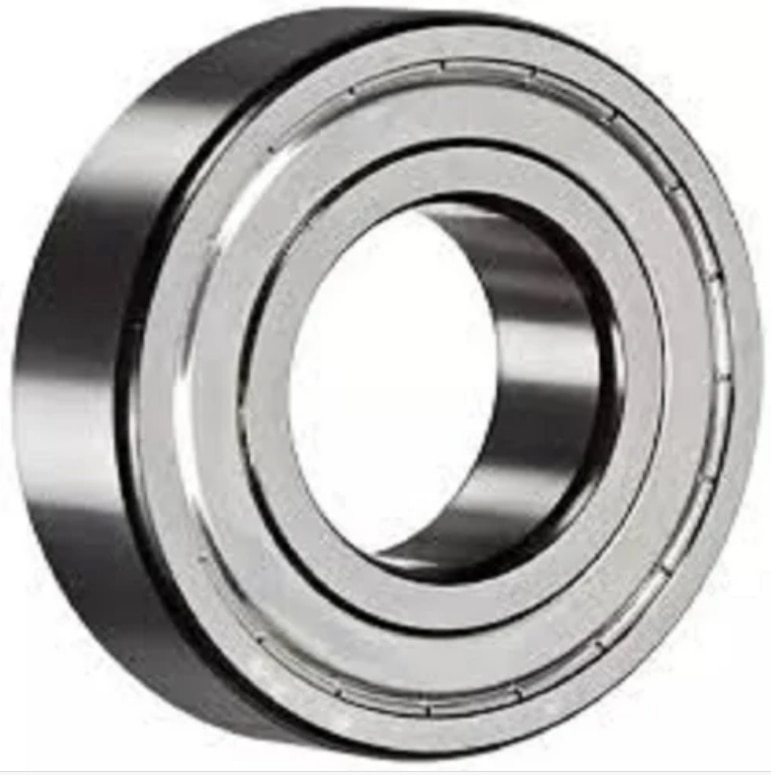 | Bearing Bearing Type Self Aligning Ball Bearing Number of Rows Single Row Bore Diameter (mm) 40mm Application Industrial Weight Depending upon the size of... View product → |
Frequently asked questions
What does 40 mm mean in a FAG ball bearing specification?
“40 mm” normally identifies the bearing bore, not its outside diameter or width. Confirm the complete bore × outside diameter × width dimensions before ordering.
How do you match a FAG ball bearing to a machine?
Compare the bearing’s load ratings, required life, operating speed and misalignment limits with the machine’s actual radial and axial loads, duty cycle and shaft conditions.
What should you check before mounting a 40 mm FAG bearing?
Check the shaft and housing dimensions, fits, shoulder geometry, mounting method and alignment. Confirm that the selected fit will not damage the bearing or prevent proper adjustment.
How should you choose seals and grease for a FAG bearing?
Choose sealing and lubricant for the machine’s temperature, dust, water exposure, speed, relubrication access and chemical environment. Verify the bearing marking and grease compatibility before installation.
Keywords